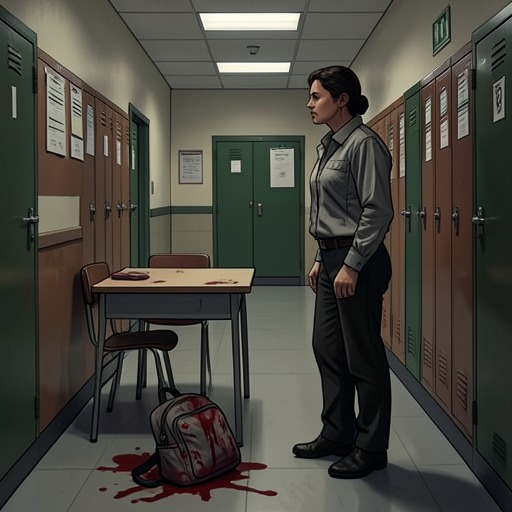
Matt Kellner’s fish and cat disappearance
The ShardsMatt Kellner’s fish and cat disappearance turns an ordinary detail of his Encino pool house into an early warning sign that Bret cannot understand at the time. The aquarium is suddenly empty, its filters silent, and Matt’s cat Alex is gone; Matt says he does not know what happened. When Matt later disappears, these losses join a wider pattern associated with the Trawler. The episode matters not because it resolves what happened to the animals, but because its unanswered questions become part of the evidence through which Bret interprets Matt’s fate.
The Aquarium and the Missing Cat
Matt’s pool house had been part of Bret’s routine since the summer of 1980, when the two met in Buckley’s summer program and began spending time together. Its long aquarium, stocked with fish and lit in blue, green, and purple, was among the room’s defining features. Alex, Matt’s cat, sometimes settled in front of the tank. The fish and the cat belonged to the ordinary surroundings of a place Bret knew well, rather than appearing at first as clues in a case.
On Labor Day in 1981, after Bret and Matt had been together in the room, Bret noticed that the aquarium’s cover was missing and the tank was empty. The lights were still on, but the filters had been switched off, leaving the bubbling sound Bret associated with the aquarium absent. Matt had returned to find the fish gone and said he did not know what had happened. He was searching for his pipe rather than investigating the empty tank; Bret saw it on the nightstand. Matt speculated that they might never know what had happened, and the two laughed about the mystery.
When Bret asked whether the cat could have taken the fish, Matt answered that Alex was missing too. Neither disappearance was explained. The exchange ends in laughter, but that laughter does not amount to an answer or to closure between the two boys. Bret leaves without saying goodbye, while Matt resumes his familiar, unhurried routine. The missing animals remain an unresolved disturbance in a scene that otherwise feels like the end of a summer and of their shared pattern of meetings.
From Domestic Absence to a Pattern
The missing fish and cat take on a different significance against the home invasions that began in the hills above the San Fernando Valley in 1980. At first, the crimes appeared random: people of different ages, genders, and household arrangements were targeted. One recurring clue, recognized only later as part of the Trawler’s pattern, was the disappearance of pets belonging to the intended victim and sometimes other animals in the neighborhood before an attack. The animals could be of many kinds, and in some cases three were sacrificed before an assault. At the time, the reason for their disappearance and what happened to them remained unknown.
That broader pattern does not establish, by itself, who took Matt’s fish or Alex. It does, however, make the losses at Matt’s home retrospectively legible as possible warning signs. The distinction matters: the event supplies a connection Bret can draw, not a conclusive account of the animals’ fate. The book lets the ordinary absence of pets acquire menace without turning uncertainty into proof.
Matt’s Disappearance and Bret’s Suspicion
When Matt stopped appearing at school in the fall, his absence initially seemed compatible with his habits. His family did not immediately know when he had left, and the missing red Datsun and unlit guesthouse became apparent only after several days. Bret, however, recognized that the disappearance did not feel random. Alongside the empty aquarium and missing cat, he recalled anonymous silent phone calls and furniture rearranged inside the residence. These details led him to fear that Matt might be another victim of the Trawler.
Bret also resists the conclusion even as he forms it. Matt was male, unlike the three young women whose disappearances and deaths had dominated public attention, and Bret wonders whether the apparent pattern might be mistaken or incomplete. The possibility that other male victims had gone unrecognized further unsettles any simple account. The vanished animals therefore work in the narrative both as a clue and as a source of uncertainty: they encourage Bret to connect Matt’s disappearance to a larger sequence, while leaving open what happened in Matt’s house.
Evidence and the Unresolved Official Account
Later, Matt’s father Ronald tells Bret that Matt could not have driven the distance associated with the supposed trip to Laguna Beach. Ronald had taken the Datsun to a dealership to replace a headlight and noted the mileage; when the car was returned after the period in question, he compared the reading and concluded it had not traveled the claimed hundred and forty miles. This detail strengthens Bret’s sense that the account of Matt’s absence does not add up, but it does not independently identify who was responsible.
Photographs Ronald shows Bret further unsettle the official explanation. One depicts an animal suspended from a pool-house column and another shows Alex’s head at the edge of the pool. The images make clear that the cat’s disappearance was not an ordinary loss, but they do not establish who killed Alex. Bret doubts the account that Matt, during a drug-related crisis, killed the cat and died after ingesting a large quantity of Quaaludes: he remembers Matt as too passive and impaired even to get up for a remote control, and the reported drug level seems inconsistent with the actions attributed to him. The fish, meanwhile, remain unexplained in the evidence presented here.
The contrast between the missing animals at the pool house and the later photographs is central to the episode’s lasting force. What began as an empty tank and a missing pet becomes entangled with a disputed death and with Bret’s attempt to reconstruct events from fragments. The book supplies grounds for suspicion, not a final resolution of who took the fish, what happened to Alex, or who was responsible for Matt’s death.